
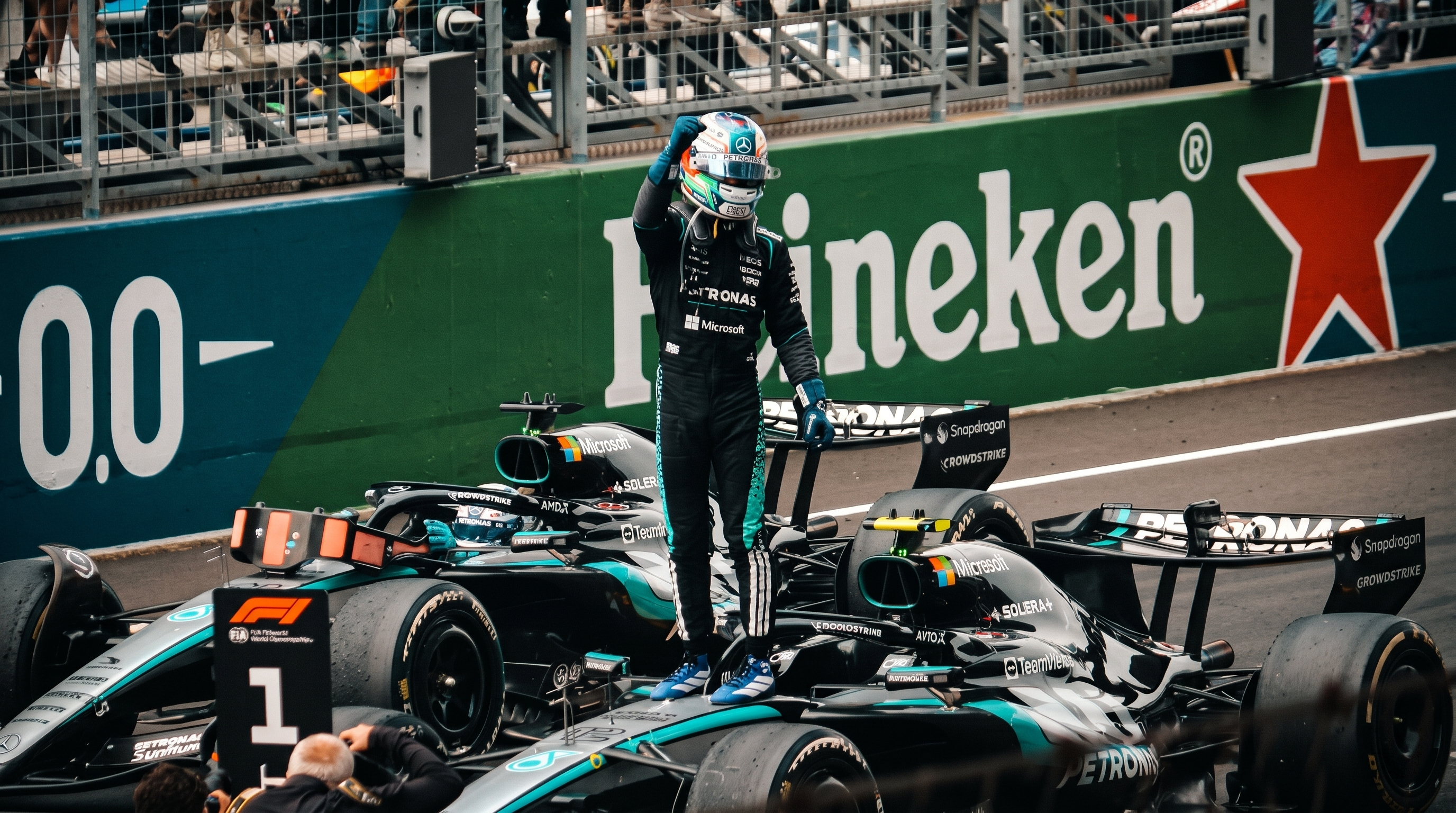
The Championship Clinch: Antonelli’s Match Point
Kimi Antonelli arrives at the Autódromo Hermanos Rodríguez with 365 points, holding an insurmountable 123-point advantage over teammate George Russell (242) and 124 points over Lewis Hamilton (241). Lando Norris, Max Verstappen, and Charles Leclerc are mathematically eliminated.
To guarantee the 2026 World Drivers’ Championship, Antonelli requires just two points (a 9th place finish), irrespective of Russell’s result. Even in the scenario of a points tie at the Abu Dhabi finale, Antonelli wins on countback, possessing nine victories to Russell’s theoretical maximum of eight. Clinching on Sunday writes the 20-year-old into the history books as the sport’s youngest-ever World Champion, displacing Sebastian Vettel. Securing the crown in his sophomore season mirrors the rapid ascents of Jacques Villeneuve (1997) and Lewis Hamilton (2008).
In the Constructors’ Championship, Mercedes holds a commanding 607 points, 133 clear of Ferrari. While mathematically possible for Brackley to clinch the WCC in Mexico, the permutations demand a Mercedes 1–2 finish coupled with a Ferrari double-DNF. The more realistic WCC lock-in venue remains Interlagos.
The FP1 Rookie Takeover & Technical Handicap:
The weekend’s technical baseline will be severely disrupted by a mass FP1 rookie deployment to fulfill mandatory FIA regulations. Ten race seats will be handed over for the opening 60 minutes: Frederik Vesti (for Russell), Ayumu Iwasa (for Verstappen), Leo Fornaroli (for Norris), Freddie Slater (for Bortoleto), Nikola Tsolov (for Lawson), Gabriele Minì (for Colapinto), Ryo Hirakawa (for Ocon), Jak Crawford (for Stroll), Luke Browning (for Albon), and Colton Herta (for Bottas). Ferrari is the sole front-running exception, running both Leclerc and Hamilton.
Sitting out FP1 at 2,285 meters above sea level (yielding 25% less air density) aggressively penalizes title contenders. The missing 60 minutes are required to execute three primary altitude calibrations:
1)Active Aero Thresholds: Calibrating Driver Adjustable Bodywork (DAB) stall mapping to ensure the physical transition from high-downforce Z-mode to low-drag X-mode executes cleanly in thin air.
2)Thermal Mapping: Managing the heat rejection and strict thermal mapping of the downsized 2026 internal combustion engine.
3)MGU-K Lift-and-Coast: Dialing in manual lift-and-coast points for the 350kW MGU-K. With the MGU-H eliminated and aerodynamic drag reduced by 25%, electrical braking resistance profiles are fundamentally altered.
The Altitude Paradox: Active Aero & Tyre Thermals
Pirelli has allocated its softest tyre range: C3 (Hard), C4 (Medium), and C5 (Soft). The Hermanos Rodríguez asphalt is notoriously smooth with low macro-roughness, resulting in a severe 5/5 track evolution metric. The 2026 active aerodynamics amplify Mexico’s inherent thermal problem:
1)Core Freezing: Travelling down the 1.2km main straight, the 25% reduction in atmospheric drag means the tyres experience almost zero vertical compression or carcass flexing. Core temperatures freeze and violently drop out of the operating window.
2)Surface Overheating: Through the winding Foro Sol stadium section, the 25% loss of aerodynamic downforce forces the cars into chronic sliding over the smooth asphalt. Drivers arrive at heavy braking zones with frozen tyre cores but heavily blistered tread surfaces.
Telemetry Matrix & Battlegrounds
Because the 2026 regulation machinery has yet to navigate Mexico’s extreme altitude, the following benchmark figures are generated via our lap-time simulation model and high-altitude powertrain dyno projections.

Mercedes: The M17 PU provides the most stable high-altitude architecture, topping the speed trap at 358 km/h. A highly efficient single-stage turbocharger successfully delays battery clipping. However, the W17 chassis is proving too stiff for the Foro Sol, generating low-speed understeer and micro-sliding (+0.22s deficit, 0.13s deg).
Ferrari: Maintaining a strong 355 km/h top speed, but Fred Vasseur has noted internal anxiety over cooling capacity. Ferrari is running conservative engine maps—dropping ICE output by 5% to 7%—to survive the thin air. The SF-26 generates excellent out-laps, but snappy MGU-K torque delivery out of the slow corners pushes C5 degradation to 0.11s.
McLaren: The mechanical benchmark through the Foro Sol. McLaren’s pull-rod front suspension provides exceptional curb compliance, protecting the delicate C5 tyre and yielding a class-leading 0.08s degradation rate. Their 354 km/h top speed is heavily drag-limited by bulkier cooling sidepods required to keep the customer Mercedes engine alive.
Red Bull: The RB22 faces a severe performance deficit in thin air. The Red Bull-Ford PU suffers from thermal degradation and premature electrical clipping, managing only 351 km/h in X-mode. Aggressive traction instability through the stadium section (+0.38s) melts the C5 tyres, yielding an unsustainable 0.18s degradation rate.
Technical Upgrade Packages (Mexico City Spec)
Team Aerodynamic & Cooling Upgrades
1)McLaren: Largest high-downforce upper wing element paired with a slender central element. Asymmetrical cooling gills on the right sidepod and oversized brake ducts. Venturi floor tunnel cutouts optimized to flow air to the diffuser at slow speeds.
2)Ferrari: Monaco main plane rear wing with a revised low-drag beam wing. Optimized internal fluid dynamics and slightly expanded central top-deck cooling exit (no massive bodywork bulges). Forward floor edge lips added to prevent ambient air leaks over stadium curbs.
3)Mercedes: Ultra-high downforce rear wing with a winglet cascade. Actuators mapped for a steeper Z-mode attack angle. Enlarged internal cooling ducts and a high-flow chimney exit. Revised carbon cladding on front suspension fairings to soften mechanical resistance on corner entry.
4)Red Bull: Aggressive multi-plane winglets around the rear wing actuator box to maximize DRS opening efficiency. Expanded engine cover shoulder line and massive drag-inducing cooling louvres on sidepods. Re-angled innermost underfloor fences to clean Y250 vortex flow and cure low-speed understeer.
When the championship contenders finally reclaim their cockpits for FP2, engineers will immediately pivot away from aero correlation and focus entirely on preventing terminal brake and power unit overheating. If Antonelli’s Mercedes survives the thermal load through Friday’s long runs without compromising tyre life in the stadium, the 2026 World Championship will likely be sealed on Sunday afternoon.

Leave a Reply