
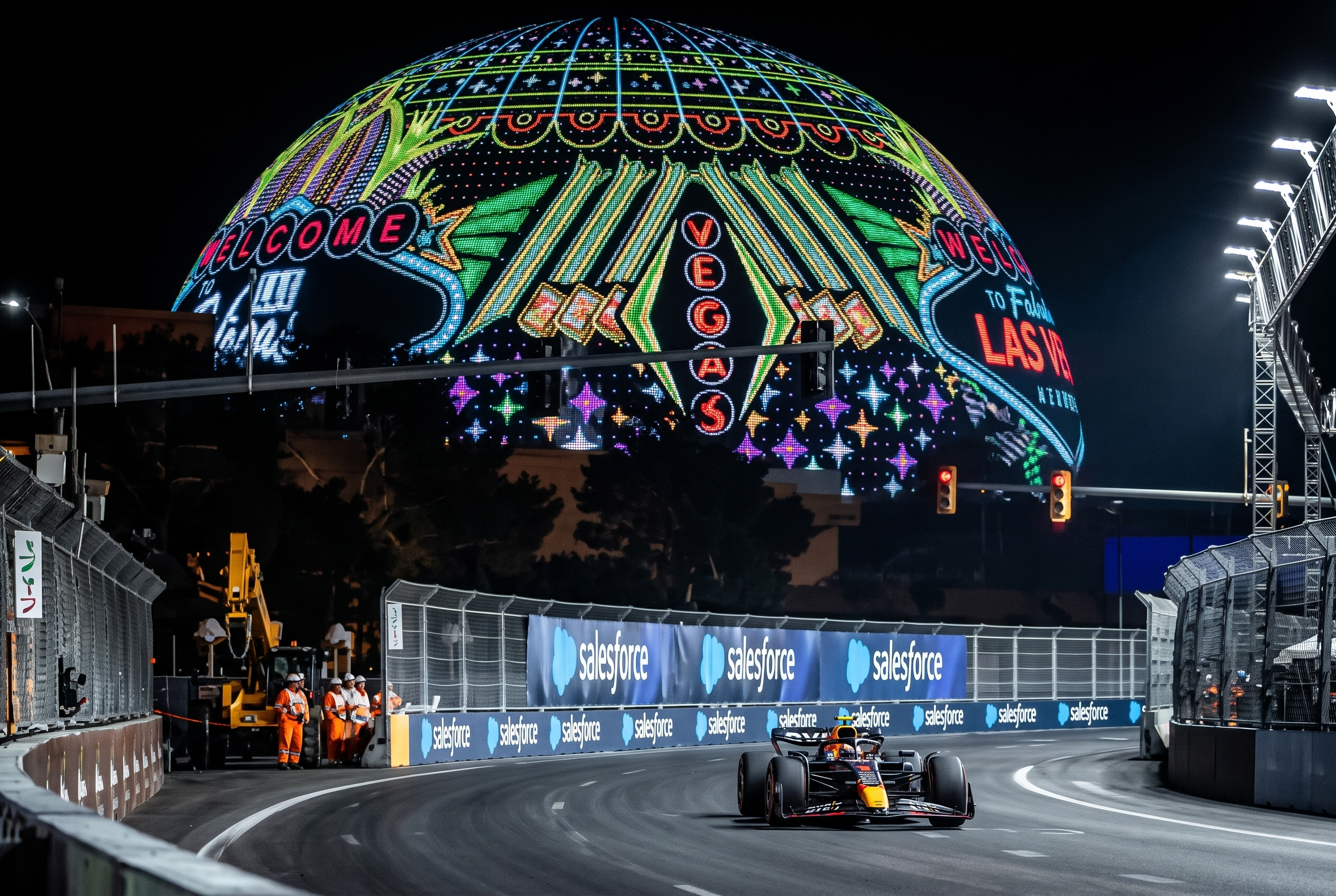
Paddock Talks & Championship Standings
Kimi Antonelli’s title coronation in Mexico (390 points) and Mercedes’ Constructors’ Championship lock in Brazil have removed the overarching title arithmetic from the final triple-header of 2026. Coming off Lando Norris’s victory at Interlagos ahead of Max Verstappen and rookie Isack Hadjar, the operational focus across the pit lane shifts entirely to the three-way battle for second in the Drivers’ standings.
Verstappen holds the advantage on 279 points, pursued closely by George Russell (262 points) and Lewis Hamilton (261 points). Separating those three drivers over the final rounds in Nevada and the Middle East comes down to a narrow technical test: getting the front axle to work on the coldest circuit of the season without sacrificing the straight-line efficiency required to survive the Las Vegas Strip.
Circuit Physics & Tyre Thermodynamics
Las Vegas is fundamentally a thermal problem disguised as a power circuit. The 1.9 km flat-out blast from Turn 12 to Turn 14 acts as a high-speed convective wind tunnel. With late-night ambient temperatures forecast to sit near 10°C and track temperatures hovering between 10°C and 13°C, airflow over the unloaded front tyres strips heat out of the tread surface and bulk carcass faster than the chassis can generate it.
In 2026 Straight Mode, the flattened front and rear wing profiles shed vertical aerodynamic load down the Strip, reducing friction at the contact patch when the tyres need it most. By the time drivers hit the Turn 14 braking zone from 350+ km/h, the front rubber has dropped below its glass-transition operating window.
A cold, rigid tread cannot key into the smooth street asphalt under peak hydraulic braking force. Instead of gripping, the front axle locks, flat-spotting the tyre or creating localized surface shearing. That micro-tearing triggers immediate cold-surface graining on Pirelli’s C5 Soft and C4 Medium compounds, shrinking the contact patch and trapping the driver in a cycle of reduced grip and further sliding.
Aerodynamic Configurations & 2026 Telemetry
Every team faces an unforgiving setup trade-off between straight-line velocity and front-axle temperature. Adding wing angle sinks energy into the tyres to prevent graining, but the resulting drag penalty increases electrical demand on the 350 kW MGU-K, triggering early end-of-straight clipping.

1) Mercedes (W17): Brackley arrives with the most complete baseline package in the field. Running a low-downforce single-element beam wing, the W17 pairs class-leading terminal speed (346–349 km/h) with sustained electrical deployment that resists late-straight derating. Because the chassis generates strong mechanical front-end heat, Mercedes can run skinny wings without destroying the tyres, while dedicating FP1 mileage to testing a 2027-spec turbocharger assembly.
2) Red Bull Racing (RB22): Red Bull deploys its Monza/Baku-spec ultra-low-drag rear wing and trimmed beam wing. The RB22 matches Mercedes on raw acceleration and top-end speed (345–348 km/h), though it experiences moderate MGU-K clipping over the final 250 meters into Turn 14 when running without a tow. Its primary limitation is an average front warm-up profile that leaves a slight braking vulnerability on cold out-laps.
3) McLaren (MCL40): Unlike its rivals, Woking brings a brand-new floor assembly to Las Vegas as a foundational test for its 2027 aerodynamics, paired with low-drag sidepods and rear wing trim. While shorter gearing and baseline drag leave the MCL40 3 to 4 km/h behind Mercedes and Red Bull on the Strip, its suspension kinematics switch the front tyres on rapidly, offering the best graining protection over a race stint.
4) Scuderia Ferrari (SF-26): Maranello faces a severe technical compromise. The SF-26 inherently struggles to generate front-tyre temperature in cold conditions. To keep the front axle alive for Turn 14, Ferrari is forced to carry more wing angle than its rivals. That added drag drops its projected terminal speed to 339–342 km/h and drains the battery early, resulting in severe MGU-K clipping before the braking zone.
Predictions
Saturday Qualifying Top 3:
1)Kimi Antonelli (Mercedes): The W17 combines the highest terminal speed projection with strong front-axle warm-up. Unburdened by championship risk, Antonelli can attack the braking zones on the C5 compound without leaving thermal margin on the table.
2)Lando Norris (McLaren): The MCL40’s rapid front-tyre preparation is tailor-made for freezing midnight tarmac. What Norris concedes in terminal velocity down the Strip, he will recover under braking into Turns 1, 5, and 14.
3)Max Verstappen (Red Bull): The RB22 will dominate the full-throttle sectors, but its average cold-tyre warm-up will cost Verstappen a fraction of a second in peak longitudinal bite during the single-lap shootout.
(Note: Both Ferrari SF-26 entries face a low risk of missing Q3 entirely due to the compound penalty of cold-tyre sliding and severe straight-line clipping).
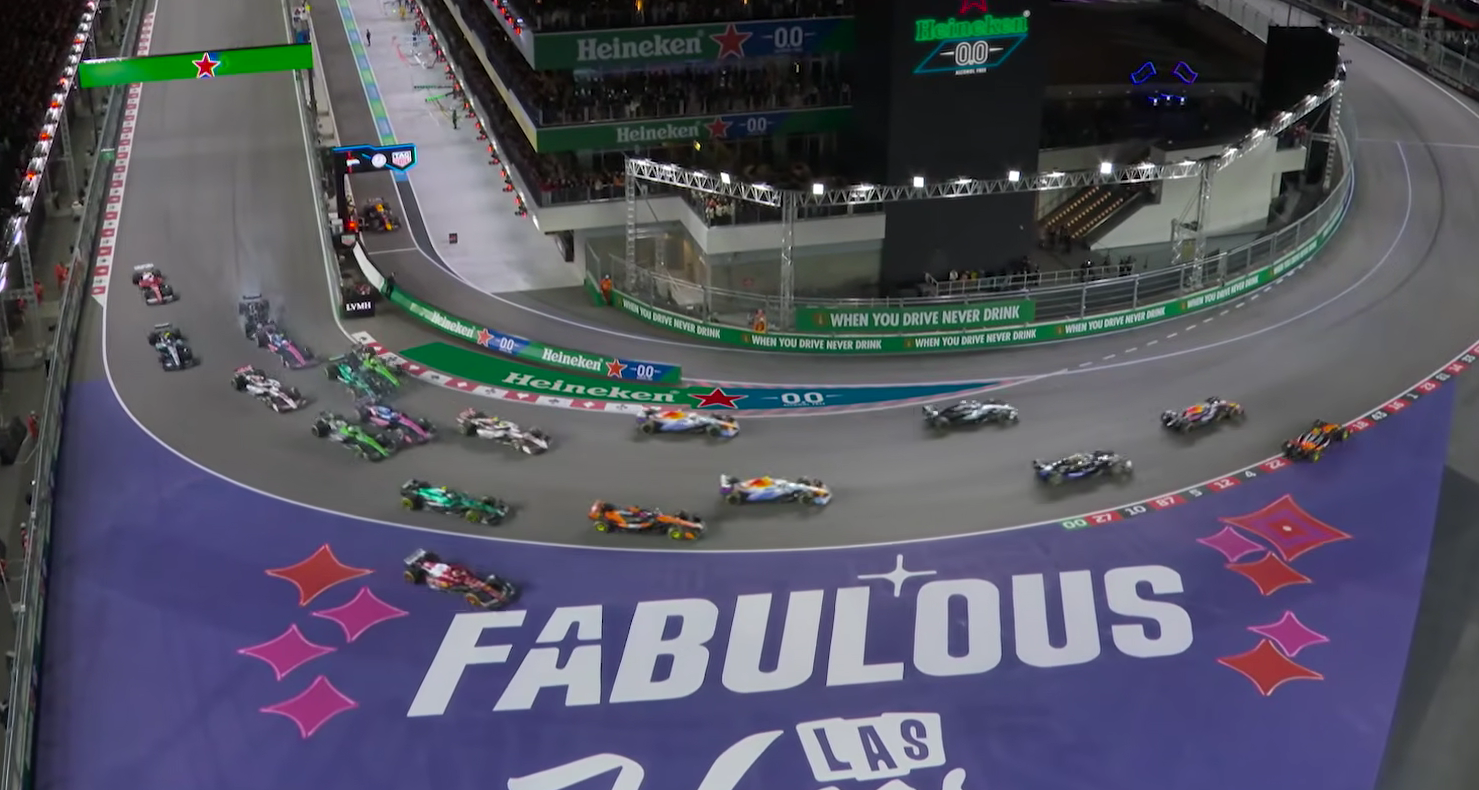
Sunday Grand Prix Top 3 (10:00 PM Local / 50 Laps)
1)Max Verstappen (Red Bull): Over a 50-lap stint, Red Bull’s low-drag efficiency dictates track position. Once the tyres stabilize at race temperature, Verstappen’s straight-line speed makes the RB22 straightforward to pass with in Overtake Mode and virtually impossible to re-pass down the Strip.
2)George Russell (Mercedes): Combining low MGU-K clipping with consistent C4 Medium management, the W17 is built for long-run efficiency here. Russell has the straight-line protection to hold off McLaren and capitalize on Ferrari’s thermal struggles to take control of second place in the championship.
3)Lando Norris (McLaren): As ambient temperatures drop over the second half of the race and cold-surface graining sets in across the field, the tyre-friendly MCL40 will come alive. Norris is best positioned to punish rivals who suffer front lock-ups in the closing stints.
Ultimately, Las Vegas is an extreme thermodynamic test, not just a drag race. With the championship hardware already locked inside the Mercedes garage, Verstappen, Russell, and Hamilton are left to fight for P2 under heavy braking at Turn 14. Success this weekend focuses on top speeds on the straights and maintaining the right tyre temperature.

Leave a Reply