
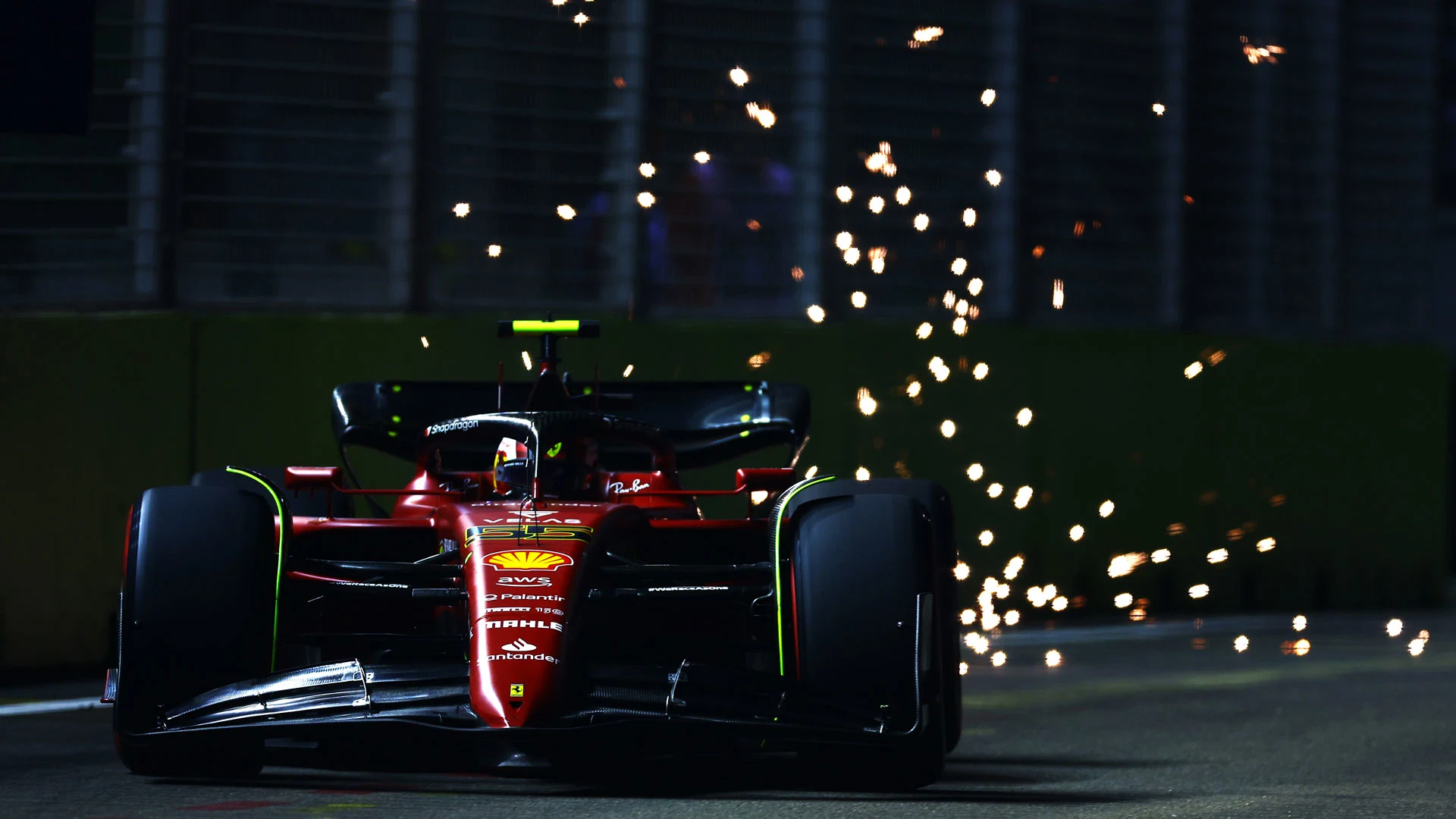
Marina Bay’s 4.927 km, 19-corner layout is an uncompromising environment for the 2026 regulations. Only three meaningful acceleration zones interrupt a lap dominated by low-speed rotation, heavy braking, and severe longitudinal traction events.
This weekend introduces a new operational bottleneck: the first Singapore Sprint. The parc fermé constraint leaves teams with just one 60-minute practice session on a green street surface to solve a fundamentally opposing day-to-night operating window. Get the mechanical balance wrong on Friday afternoon, and the entire weekend is heavily compromised.
Circuit DNA & The Sprint Parc Fermé Dilemma
The revised Marina Bay layout bypasses the old bay grandstand section, producing a 62-lap, 305.337 km Grand Prix. Mercedes arrives with the strongest historical pedigree (five constructors’ victories), while Lewis Hamilton holds four poles, four wins, and the official lap record (1:33.808). Conversely, Max Verstappen is still chasing his first Singapore victory after four podiums and three second-place finishes.
The technical challenge for 2026 is compounded by the Sprint format:
1) The 60-Minute Window: Friday’s FP1 is the only opportunity to establish ride height, damper rebound, and mechanical balance before Sprint Qualifying locks the cars down.
2) The Thermal Swing: The car must work across radically different thermal profiles. Saturday’s Sprint begins in daylight heat at 17:00 local time, while Grand Prix Qualifying (21:00) and Sunday’s race (20:00) run under the floodlights. A setup tailored for Saturday afternoon heat risks turning excessively stiff or thermally inefficient once the asphalt cools.
Active Aero and the Marina Bay Energy Profile
Marina Bay does not offer long periods of sustained full throttle, concentrating the benefit of low-drag deployment into short bursts.

Pirelli rates braking demand at the maximum 5/5. The 350 kW MGU-K is repeatedly tasked with recovering substantial kinetic energy into Turns 7 and 14. Engineers must prioritize rear-axle braking stability without sacrificing electrical torque fill efficiency on corner exit.
Tyres: The C5 Strategic Wild Card
Pirelli has nominated its softest available allocation: C3 (Hard), C4 (Medium), and C5 (Soft).
1) Surface Metrics: Track evolution sits at a maximum 5/5. Braking is 5/5, and Traction is 4/5. Asphalt abrasion and grip are moderate (3/5).
2) The Thermal Load Path: Night track temperatures will hover around 30–35°C. Outright carcass overheating is limited; degradation is predominantly rear-axle driven through repeated low-gear exits.
3) The Sprint & Sunday Gamble: The baseline strategy is a strict one-stop, dictated by a 22-second pit-loss penalty. However, the C5 Soft demonstrated notable durability in Budapest, Monza, and Baku. With Lewis Hamilton and Carlos Sainz exhibiting late-stint viability in 2025, the C5 stands as a tactical option for both Saturday’s Sprint and an aggressive opening stint on Sunday.
Pre-Weekend Simulation Matrix (Correlated from Street Circuits Telemetry)
Because the 2026 regulation machinery has yet to turn a competitive wheel at Marina Bay, the following benchmark figures have been generated by our lap-time simulation model projecting low-speed mechanical grip, curb compliance, and braking telemetry from Monaco and Baku onto Singapore’s 19-corner geometry.

The Four Technical Battlegrounds:
1. Ferrari: The Mechanical-Grip Benchmark
Ferrari leads the simulation matrix with a class-leading 48.2 km/h hairpin apex speed and the lowest C5 degradation rate at +0.054 s/lap. The SF-26’s compliant suspension heave springs and anti-squat geometry limit rear-wheel micro-slip upon throttle roll-on, holding an ultra-low 0.4° front-end slip angle. By preserving the rear tire carcass out of tight exits like the Turn 13 hairpin, Ferrari arrives as the mechanical reference point, provided the pit wall avoids operational strategy missteps.
2. McLaren: Traction Punch & Masked Deficits
The MCL40 sets the launch benchmark, rocketing from 0 to 150 km/h in 2.52 seconds with an initial longitudinal spike of 1.92 Gx. While Lando Norris has battled a persistent 1–2 km/h straight-line deficit, Marina Bay’s short full-throttle bursts mask top-end drag penalties. Backed by solid low-speed rotation (46.8 km/h apex) and a manageable 0.9° slip angle, McLaren possesses the mechanical platform needed to protect its 18-point Constructors’ Championship margin over Red Bull.
3. Red Bull: Torque Fill vs. Kerb Compliance
Fresh off Red Bull-Ford Powertrains’ maiden works victory at Sepang, the RB22 delivers punchy low-gear acceleration (2.54 s to 150 km/h) driven by aggressive 350 kW MGU-K torque curves. However, the stiff roll platform required to seal its ground-effect underfloor limits compliance over Marina Bay’s street crowns and curbs. This creates micro-oscillations under heavy traction, translating into a higher C5 wear rate of +0.076 s/lap. Verstappen must rely on quick rotation and electric torque rather than mid-corner rolling speed to pursue his elusive first Singapore win.
4. Mercedes: Low-Speed Understeer Meets a Street Circuit
Mercedes faces an acute engineering hurdle. Paddock reports from Sepang confirmed that their latest aerodynamic package introduced unwanted drag and severe low-speed understeer. This is quantified in the simulation by a field-worst 1.4° slip-angle delta and an overslowed 45.4 km/h minimum apex speed. Furthermore, the rear axle’s roll stiffness triggers localized surface spikes on corner exit, pushing C5 degradation to +0.098 s/lap. With George Russell facing a potential grid penalty following his Malaysian power unit failure, Mercedes cannot afford setup correlation delays in FP1.
Environmental Volatility: The 35% Equatorial Rain Risk
Humidity will sit between 75% and 85%, creating high physiological stress where drivers routinely shed up to 3 kg of fluid across 62 laps.
While Friday’s FP1 and Sprint Qualifying carry a modest 15% rain probability, Saturday and Sunday see a 35% chance of localized tropical downpours. A damp opening lap immediately rules out the C3 Hard as a viable opening compound, demanding sharp operational radar tracking on the pit wall.
What to Watch for in Friday Practice
With only 60 minutes before parc fermé clamps down, watch FP1 throttle traces closely. Engineers will focus on whether Mercedes can dial out their 1.4° front-end understeer push without inducing high-speed oversteer, while monitoring whether Ferrari’s low degradation holds over continuous simulated Sprint runs.


Leave a Reply