
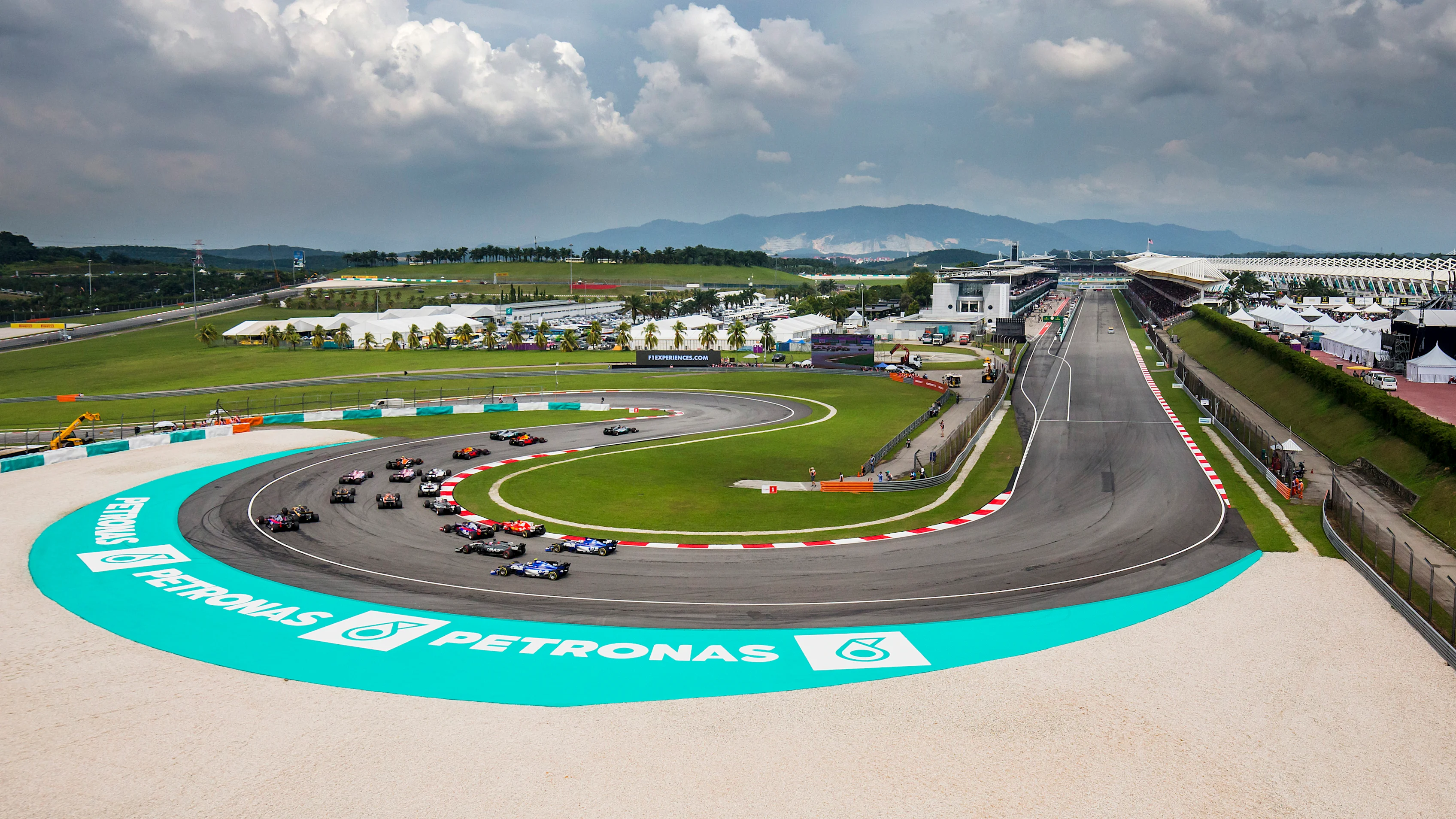
Formula 1 heads to Malaysia this weekend, with the PETRONAS Sepang International Circuit stepping in to host the 2026 Bahrain Grand Prix. The venue forces an uncompromising engineering trade-off: 65% to 70% of the 5.543 km lap is spent in low-drag Straight Mode, yet the loaded Sector 2 sweeps through Turns 5 to 8 demand absolute floor-seal authority in high-downforce Corner Mode.
With track temperatures routinely exceeding 50°C and aggregate asphalt unresurfaced since 2017, the team that stabilizes its aerodynamic platform through high-speed transitions without hemorrhaging top speed along the parallel 920-meter straights will dictate the weekend.
Circuit DNA & The 2026 Aerodynamic Paradox
Running 56 laps over 15 corners (5 left, 10 right), the circuit represents the most demanding aero-elastic test of the 2026 regulatory era. The FIA has designated four active Straight Mode (X-Mode) zones across the lap:

Overtake Mode detection sits at the Turn 15 hairpin exit, granting an auxiliary 0.5 MJ of MGU-K energy down the primary pit straight.
Deceleration from over 340 km/h into Turn 1 and Turn 15, alongside the heavy trail-braking entry into Turn 4, subjects the 350 kW MGU-K to immense kinetic harvesting demands. Recovering this electrical energy without destabilizing the rear axle under heavy braking is the prerequisite for aggressive deployment later in the lap.
Tyres: The Thermal Crucible
Pirelli has nominated the C2 (Hard), C3 (Medium), and C4 (Soft) compounds, deliberately omitting the C1 to force strategic spread:
1)Asphalt Micro-Roughness: Unresurfaced since 2017, the bitumen binder has worn away to expose coarse aggregate, accelerating mechanical tire wear.
2)Thermal Load Path: Ambient temperatures between 31°C and 34°C push track surface temperatures past 50°C. Long-radius lateral loads torture the front-left tyre through Turns 5 and 6, while repeated high-torque exits out of Turns 9 and 15 generate acute thermal degradation across the rear axle.
3)The Soft Tyre Dilemma: The C4 compound suffers immediate surface overheating, losing structural integrity within a single flying lap.
4)Strategic Baseline: Strategy models point toward a mandatory two-stop baseline utilizing the C2 and C3 compounds, shifting focus to whether an early undercut or a tyre-preserving overcut offers the superior race-time delta.
Pre-Weekend Simulation Matrix
Because the 2026 regulation machinery has yet to turn a competitive wheel at Sepang, the following benchmark figures are generated via our lap-time simulation model projecting real-world high-load aero telemetry from Silverstone and Spa onto Sepang’s geometric track profile.

The Four Battlegrounds
1. McLaren’s High-Speed Apex Superiority:
The MCL40 registers 222.5 km/h through the apex of Turns 5–6, outpacing the Red Bull RB22 by an enormous 10.4 km/h. McLaren’s floor design and stiff rear pull-rod geometry maintain a stable aerodynamic platform under sustained lateral G-forces. By eliminating platform roll and heave migration, Lando Norris and Oscar Piastri carry superior minimum apex speed through Sector 2 without breaking the underfloor boundary layer. The compromise is visible down the straights: at 334.8 km/h, McLaren sits at the bottom of the speed trap, leaving them vulnerable to DRS trains if they fail to lock out the front row.
2. Red Bull’s Straight-Line Weapon:
The RB22 leads the speed trap at 344.2 km/h (+9.4 km/h over McLaren). The Red Bull-Ford powertrain delivers efficient electrical deployment through higher gears, while its active wing mechanisms dump profile drag cleanly in X-Mode. However, the rigid mechanical setup required to stabilize the floor compromises compliance, resulting in a low 75.5 traction stability score and the highest C3 wear rate in the field (0.16 s/lap). Red Bull relies on dominating the braking zones and straights rather than matching McLaren’s high-speed cornering speed.
3. Mercedes’ Balanced Efficiency:
The W17 demonstrates a neutral compromise: 340.4 km/h down the straight, 218.4 km/h through Turns 5–6, and a stable degradation rate of 0.12 s/lap. Brixworth’s energy deployment algorithms avoid late-straight power clipping. Crucially, the W17’s internal heat-exchanger efficiency allows Mercedes to run tightly closed bodywork contours without cutting drag-inducing cooling louvres, preserving aerodynamic efficiency in 50°C track heat.
4. Ferrari’s Traction vs. Super-Clipping:
The SF-26 earns an 81.4 traction stability index out of Turn 15 and the lowest tyre degradation in the field at 0.09 s/lap. The car’s compliant suspension protects the rear tire carcass under traction. However, the power unit suffers from mid-straight energy starvation; the MGU-K prematurely enters recovery mode before the braking marker, clipping terminal speed at 337.8 km/h. To challenge for the win, Ferrari must lean on tyre preservation and execute an aggressive overcut during the pit window.
The Four Technical Configurations at a Glance

Environmental Volatility: Humidity & The 4:00 PM Squall
Relative humidity between 75% and 85% significantly lowers ambient air density. Turbochargers must spin at higher shaft speeds to sustain nominal boost pressure, pushing compressor stages near their thermal efficiency ceilings while accelerating driver fatigue.
Simultaneously, equatorial convective instability brings a high probability of a late-afternoon tropical squall around 4:00 PM local time. These sudden cloudbursts rapidly flood low-elevation sectors such as Turns 4 and 9, completely neutralizing grip and forcing teams to keep pit crews on standby for immediate, reactive tire pivots.
What to Watch for in Friday Practice
FP1 and FP2 will reveal whether Red Bull can soften its mechanical platform to cure its 10.4 km/h deficit in Sector 2 without stalling its underfloor ground effect over Sepang’s surface bumps.
Telemetry traces from Friday’s long runs will confirm whether Ferrari’s 0.09 s/lap degradation advantage is large enough to offset their MGU-K straight-line clipping down Sepang’s parallel straights.


Leave a Reply