
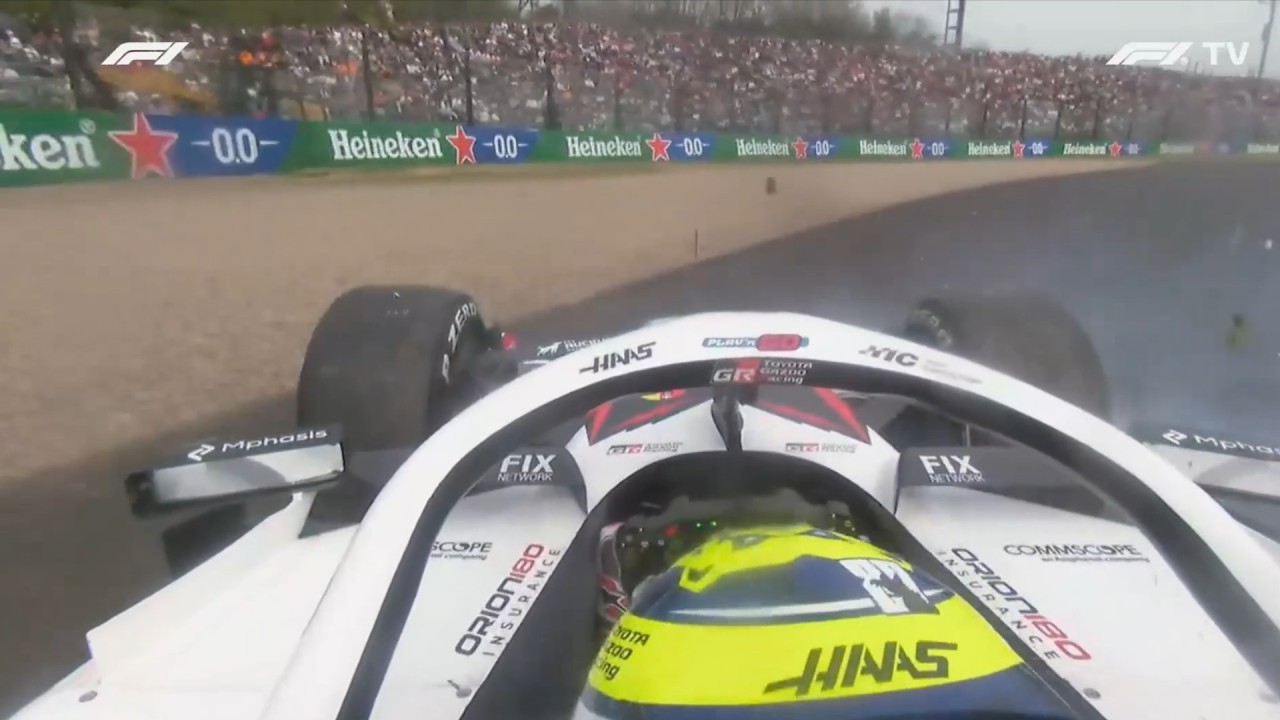
Ollie Bearman’s crash at Suzuka this past weekend was incredibly scary to watch. The British driver seemingly lost control of his car down the straight and tumbled right into the barriers. He walked out of his car without major injury, but did need support from the stewards to do so. What happened in that crash wasn’t just another racing incident; it was a consequence of the 2026 F1 regulations’ closing speeds that every driver warned the FIA about, and yet nothing has changed.
Since the race, there has been a lot of analysis as to what happened and who caused the issue, but not enough has been said about the impact of the 2026 F1 regulations’ closing speeds problem that led to this accident. The warning lights that could have avoided this incident were not there, and the fact that the FIA knew about the issue with the closing speeds and did nothing to change it.
The 2026 Power Unit explained: What changed and why it matters
To understand what went wrong at Spoon Curve for Ollie Bearman, you need to understand how the new regulations work. The 2026 regulations completely changed the F1 power units, requiring a 50/50 split between electrical power and combustion. The MGU-K (motor generator unit-kinetic) is now three times more powerful than it was prior, and is the only piece responsible for energy recovery and deployment. The car’s battery is able to store 4MJ of energy at any time, but it depletes much faster when the MGU-K kicks in.
Drivers need to manage their energy so much more than ever before, thinking about it on every corner and every straight throughout the race. They need to decide when to coast and when to push, managing not only racing dynamics but also their battery.
The MGU-K operates in two modes. When it’s deploying, it acts like a motor, pushing energy from the battery to the rear wheels, accelerating the car forward. When it’s harvesting energy, think of it more like a generator, taking the energy created from resistance from the drivetrain, the resistance on the car’s rear axle, to recharge the battery.
While harvesting can happen from braking, this is quite different. When the driver presses the brake pedal, the rear light goes on, just like in most cars. However, when it’s harvesting, it doesn’t trigger the brake light. The car is still slowing down, but the driver behind doesn’t get a visual signal from the light to indicate this is happening.
Under the new regulations, the MGU-K’s harvesting is so much greater, meaning the car slows down so much more, in the range of 40–50km/h without triggering the brake light.
The MGU-K Rampdown
When a driver is above 290 km/h, the MGU-K deployment power tapers off, hitting zero as the driver reaches 355 km/h. This is called the rampdown, and it’s a regulatory requirement to prevent drivers from using only electrical power to gain their top speed.
This is an issue for drivers on the same straight but at different speeds, as they will be at different points in their rampdown, with the one at a higher speed losing MGU-K contribution, while the one at a lower speed may have some, and this multiplies as it harvests.
When a driver is deploying the MGU-K past 290 km/h, and the rampdown begins, think of it like a small drag chute popping out of the car, slowing down the amount of speed gained just a little bit, but not dramatically altering the overall speed of the car.
When the car enters harvesting mode, think of it like a large parachute being deployed, dramatically slowing the car down. But when the car enters harvesting mode, the brake light doesn’t go on, so there is no way for the driver behind to know that the driver in front is slowing down dramatically.
This isn’t an issue in retrospect. Drivers have been complaining about this for weeks. After the crash, Oscar Piastri called it out perfectly, saying, “From what I saw, there was no flashing light from Colapinto, so I don’t even think he was super clipping either, which is obviously a bit of a concern.”
How the 2026 F1 Regulations created the closing speed problem at Spoon Curve
The cause of Bearman’s Suzuka crash comes down to one sequence on lap 21, and both drivers were completely within the rules when it happened. Bearman was coming down the straight, trying to catch Alpine’s Franco Colapinto for a few laps at that point. He was the faster driver, going about 20km/h faster than the Alpine, and this was the area that Haas targeted for an overtake on lap 21.
On this lap, Colapinto downshifted far earlier than he had on any of his previous laps, transitioning to harvest just as Bearman activated his boost to make the overtake. The existing speed differential was already 20km/h in the previous lap, widened to 45km/h as Bearman deployed his boost. At 308km/h, Bearman had to swerve dramatically, causing him to crash into the barrier, as he had no signal that Colapinto had slowed down. This is why Bearman crashed at Suzuka.
After the crash, Bearman said, “It was a massive overspeed, 50 kph, which is a part of these new regulations that I guess we have to get used to. But also I felt like I wasn’t really given much space, given the huge excess speed that I was carrying. I think as a group we warned the FIA what can happen and this has been a really unfortunate result of a massive delta speed we’ve not seen before in F1 until these new regulations.”
The drivers knew about this issue, and so did the FIA
The 2026 F1 regulations closing speed issue has been flagged by drivers for weeks. The differentials are large enough to cause serious issues, and we have been hearing about this since Bahrain testing in February. This issue shouldn’t have come as a surprise to anyone on the track, and could have ended much worse than it did.
We all laughed when Max Verstappen described the racing as “mushrooms in Mario Kart” or “Formula E on steroids”, but it pointed to a much larger issue: the drivers did not have complete control of their cars as they did in years prior.
Lando Norris put it more eloquently when he said, “Honestly some of the racing, I didn’t even want to overtake Lewis. It’s just that my battery deploys, I don’t want it to deploy, but I can’t control it. So I overtake him, and then I have no battery left, so he just flies past. This is not racing, this is yo-yoing.”
The 2026 F1 Regulations Safety Problem
This is more than a racing issue; it’s a safety issue. Drivers who cannot predict when their power units will deploy or stop deploying can’t react fast enough to prevent accidents.
In Bearman’s case, he couldn’t predict at what rate Colapinto was slowing down to avoid him, nor could Colapinto predict how quickly Bearman was approaching. Bearman couldn’t predict how quickly he would close on him. When it happened, he couldn’t get out of the way quickly enough and remained on track, causing his collision.
This wasn’t a surprise for the FIA. After the Chinese Grand Prix weekend, FIA single-seater director Nikolas Tombazis noted that they had identified potential fixes, describing them as “aces up our sleeves”, but didn’t want to introduce them immediately as a “kneejerk reaction.”
They sat on these aces through Suzuka, which directly impacted Bearman’s race and his health. Frankly, he was lucky that this didn’t end worse for him.
After the race, Carlos Sainz, a director of the GPDA, was clearly frustrated, saying, “I was so surprised when they said: ‘No, we will sort qualifying answers, leave the racing alone because it is exciting’, because as drivers, we’ve been extremely vocal that the problem is not only qualifying, it is also racing. We’ve been warning that this kind of accident was always going to happen.”
The political side of the sport
He knew it, all the drivers knew it, all the teams knew about it, the FIA knew about it, and yet nothing was done. The teams have spent months preparing for the new regulations, building cars to meet the new regulations, and making the sport interesting to watch.
Three races in, Mercedes and Ferrari have emerged at the top of the table, while Cadillac and Aston Martin have struggled mightily. Any changes to the regulations impact the competitive landscape, and the teams at the top want to protect their position to secure the greatest chance at winning the Constructors’ Championship.
The money associated with a strong standings finish is enormous, and the teams at the top know that they have a real advantage under the current setup. Changes to the regulations give them the least to gain and the most to lose. Notably, both Ferrari and Mercedes have been quiet, with the loudest calls coming from the drivers who have struggled this year- Verstappen, Lando Norris, and Fernando Alonso most notably.
Tombazis directly acknowledged this tension, saying, “We need to always remember that the sport has a lot of stakeholders. The drivers, of course, are extremely important. They are the stars. But we have to also remember that this sport attracts big motor manufacturers like Mercedes, Audi, Ferrari and Cadillac.” In other words, we are trying to balance driver safety with the money on the table.
How the F1 2026 regulations review will impact the Miami Grand Prix
Now the sport is on a long break, with the cancellation of the Bahrain Grand Prix and Saudi Arabia Grand Prix due to the ongoing conflict in the Middle East. After Suzuka, the FIA released a statement noting that the new regulations have several “adjustable parameters, particularly in relation to energy management, which allow for optimization based on real-world data.”
There will be meetings that happen in this pause to evaluate the data from the first three races, but what actually happens is the key. Here’s what they should do.
Introduce warning lights for harvesting deceleration
This is the easiest change to introduce. When drivers are harvesting energy without braking, the rear light should go on to warn the drivers behind them that they are slowing down without hitting the brake.
This is an easy fix that Piastri noted after Suzuka, and one that doesn’t impact the power unit at all. The FIA should be able to deploy this change without requiring any additional sign-offs.
Race deployment level adjustments
The FIA already did this before Suzuka, reducing speed differentials through some of the high-speed corners, but the FIA should do so relative to energy rates between cars. This would be difficult to do, as it changes the racing deployment maps and thus impacts overall competitiveness. It would also require sign-off from teams, and those who have a more aggressive strategy, like Mercedes, are unlikely to agree to the change.
Circuit-specific harvesting restrictions
The FIA should examine restricting harvesting going into corners where drivers are expected to go flat out. The gap between a driver harvesting and one boosting creates a major safety issue, and restricting this here would be immensely valuable.
Spoon Curve is an obvious one, but the same issues apply, especially at Blanchimont at Spa and along the street races at Las Vegas, Singapore, and Baku. While technically feasible, it would be difficult for the FIA to enforce in real time and to simulate across the remaining races. It would likely take more than the break to implement this change.
What the FIA does over the balance of these five weeks is going to be critical, and will say a lot about who the regulations are built to serve.
What to watch for next
The 2026 regulations are brand new, and understandably, teams, drivers, and the FIA are still learning how they work on the track. However, when issues of real danger happen as a result of those regulations, the FIA needs to act to protect its stars, especially after there were so many complaints. They have options and time, and how they choose to deploy changes will say a lot about the sport overall.
Bearman may have walked away from this incident relatively unscathed, but the walls of Miami are less forgiving, and without changes, the risks to the drivers continue to be enormous.

Leave a Reply