
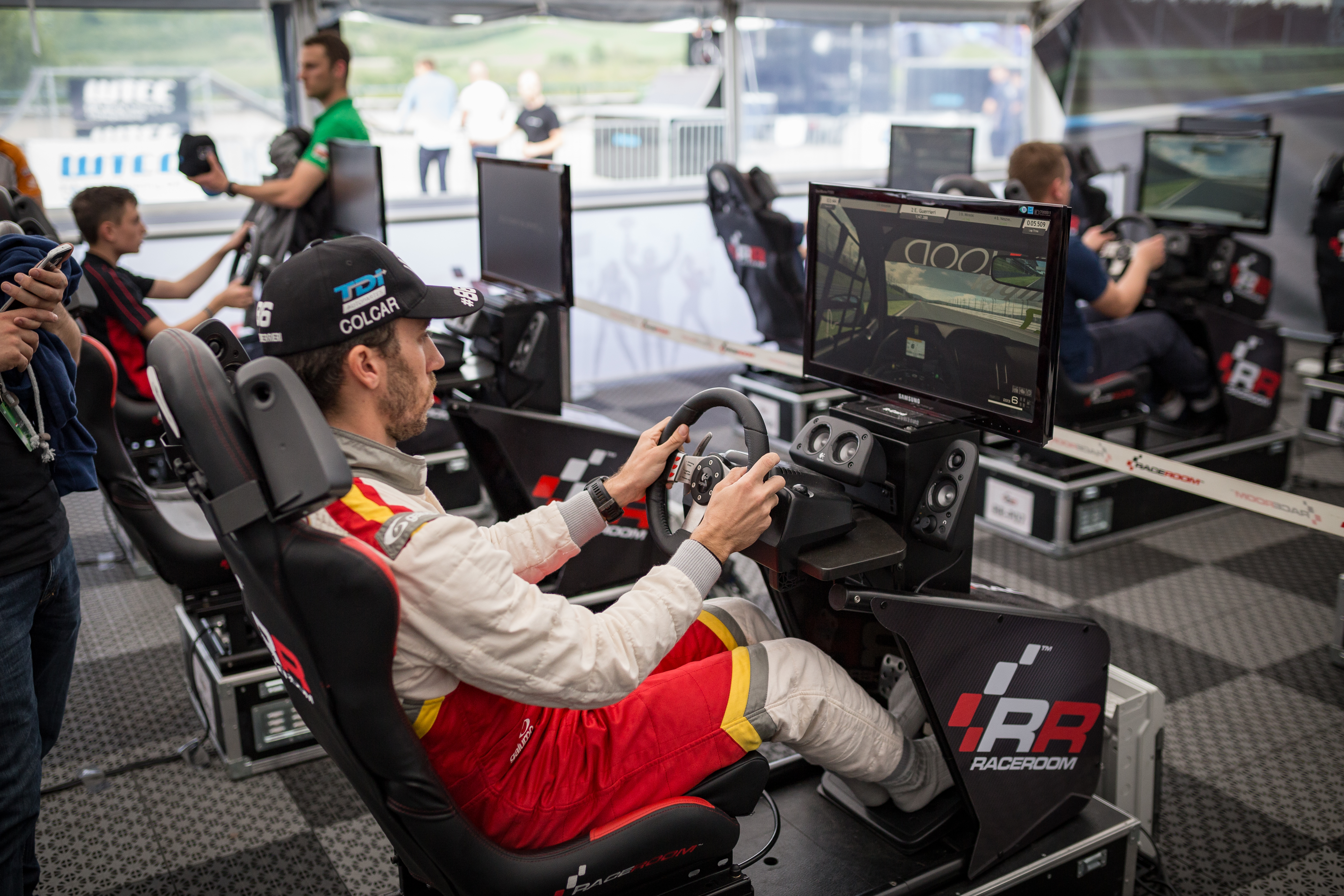
With the rise of esports sim racing since the COVID pandemic, some believe that sim racing could be a direct alternative to the traditional junior ladder pipeline to joining F1. The cost of sim rigs has become more accessible in recent years, making it easier than ever to hone one’s skills in racing without having to pay the entry fees for real-life motorsport.
Real F1 drivers have been seen racing online as well, further highlighting the perceived crossover of these two disciplines. While sim racing inside F1 teams and esports sim racing look similar, they are fundamentally solving different problems.
Sim racing vs esports
It’s important to clarify the distinction between sim racing in the context of F1 and sim racing in the context of home entertainment and esports. Sims used by teams and drivers, while practically similar, differ in a few ways from enthusiast sim rigs that fans would have at home.
Cost is the largest differentiator between the two types of simulators. Home sim setups typically cost a couple of hundred dollars at the low end, while the ones F1 teams use can cost millions.
The intended use between the two is also different. Professional sims are used as tools, backed by complex custom physics and aerodynamics models developed by each team to suit their needs. Sim rigs at home are typically used for enrichment in casual or competitive settings, such as in Assetto Corsa or iRacing, for example.
Why sim racing matters to teams
There are a couple of practical reasons why sim racing matters to F1 teams. First, there is the cost efficiency that sim racing brings. Being able to spend time in a race seat without risk to the actual car is greatly beneficial to both drivers and teams. High-fidelity factory simulators allow teams to analyze data from different conditions and setups more efficiently than with a practical car.
Then there is the benefit to drivers in developing mental racecraft. Drivers can practice maneuvers and strategies much more efficiently in a sim. Having drivers practice in a virtual environment also removes the risk to themselves or their car if anything goes wrong. Drivers benefit from sims in other areas as well, such as learning track layouts and practicing with consistent, repeatable scenarios.
Where sims fall short of the real thing
While sim racing offers many benefits in terms of efficiency, safety, and data gathering, some aspects can not be replicated in a virtual environment. Sims can simulate rotational motion, but they can’t simulate the G-forces experienced in a real car on-track.
Drivers would not experience fear or risk like they would in a real car, which could lead to discrepancies in results between sim sessions and on-track sessions. While teams can try their best to replicate real-life scenarios, real race conditions can be chaotic and unpredictable, putting drivers’ racecraft to the test.
So why do F1 teams run esports programs?
If consumer-level sim racing is ultimately a different discipline from what the pros use, then why do F1 teams bother associating themselves with esports at all? Since 2017, Formula One has been running the F1 Esports Series. They launched the series to capitalize on the growth of esports and bring F1 to a wider audience.
While teams don’t recruit drivers directly from esports, they do keep an eye out to identify potential talent from that pool of competitors. One notable exception outside of F1 is Nissan’s GT Academy, which grants the world’s top Gran Turismo players a chance to compete for Nissan in real-life motorsport events around the world.
The main barrier (aside from finances) keeping esports racers from joining F1 is that their virtual experience alone simply does not prepare them enough to handle the risk and physical requirements of real racing.
A door, not a ladder
Esports has lowered the barrier of entry to aspiring racers, which is absolutely a great thing. It has allowed more people unprecedented access to a high-level of competition and visibility that simply did not exist a decade ago. For Formula One teams, it serves as a helpful tool for audience engagement, as well as a way to identify potential talent.
The key here is not to mistake accessibility for equivalence. The skills developed in esports sim racing are valuable, but they are only part of what’s required to be competitive on a real race track. Without the physical and mental components required for physical racing, esports remains a complement to, rather than a replacement for, the traditional road to Formula One.



Leave a Reply