
Formula One has always been a dangerous sport. The 1970’s may be behind us, but the risk of injury is always there, every time a driver enters the car.
November 29, 2020, brought one of the scariest crashes in F1 history, when Romain Grosjean spent 28 seconds trapped in a fiery blaze. Amazingly, he managed to self-extricate and walk away. Today, we break down the heart-stopping moment Grosjean’s car went up in flames, and the aftermath.
Welcome to Lore Tuesdays, a weekly series through the offseason, telling you stories about the greatest moments in Formula 1. Each week, we will retell an iconic Formula One story and why it is so ingrained in Formula One history. Strap in, here we go!
Lights out, and moments before the crash
To understand how the crash occurred, let’s rewind to the start of the race.
On the day of the Bahrain Grand Prix, Romain Grosjean had qualified in P19 for Haas. At lights out, traffic immediately emerged further up the field. Going into turn 2, McLaren’s Lando Norris found himself between Esteban Ocon on the inside and Pierre Gasly on the outside. Norris made slight contact with both drivers and damaged Gasly’s front wing. With Ocon on the inside, Norris was forced to brake to avoid further contact suddenly.
Slightly further behind was Sebastian Vettel. The Ferrari driver could see Ocon, Norris, and Gasly bunched up next to each other. Vettel completed turn one between Charles Leclerc and Lance Stroll, with Norris just ahead. With Norris breaking hard ahead of him, Vettel was taken by surprise, locked up, and had slight contact with Norris and Stroll.
At this point, the midfield was moving much more slowly than expected through the beginning turns of the race. The Vettel traffic jam was positioned on the inside of the track, with drivers passing on both sides. Several metres back was Grosjean, who was positioned to pass around the outside, following his Haas teammate, Kevin Magnussen.
Just behind Kevin Magnussen’s outside line and in Grosjean’s blind spot was Daniil Kvyat. Grosjean attempted to sharply cut right and avoid traffic, but instead, he clipped Kvyat and ran straight through the barriers.
28 seconds in flames
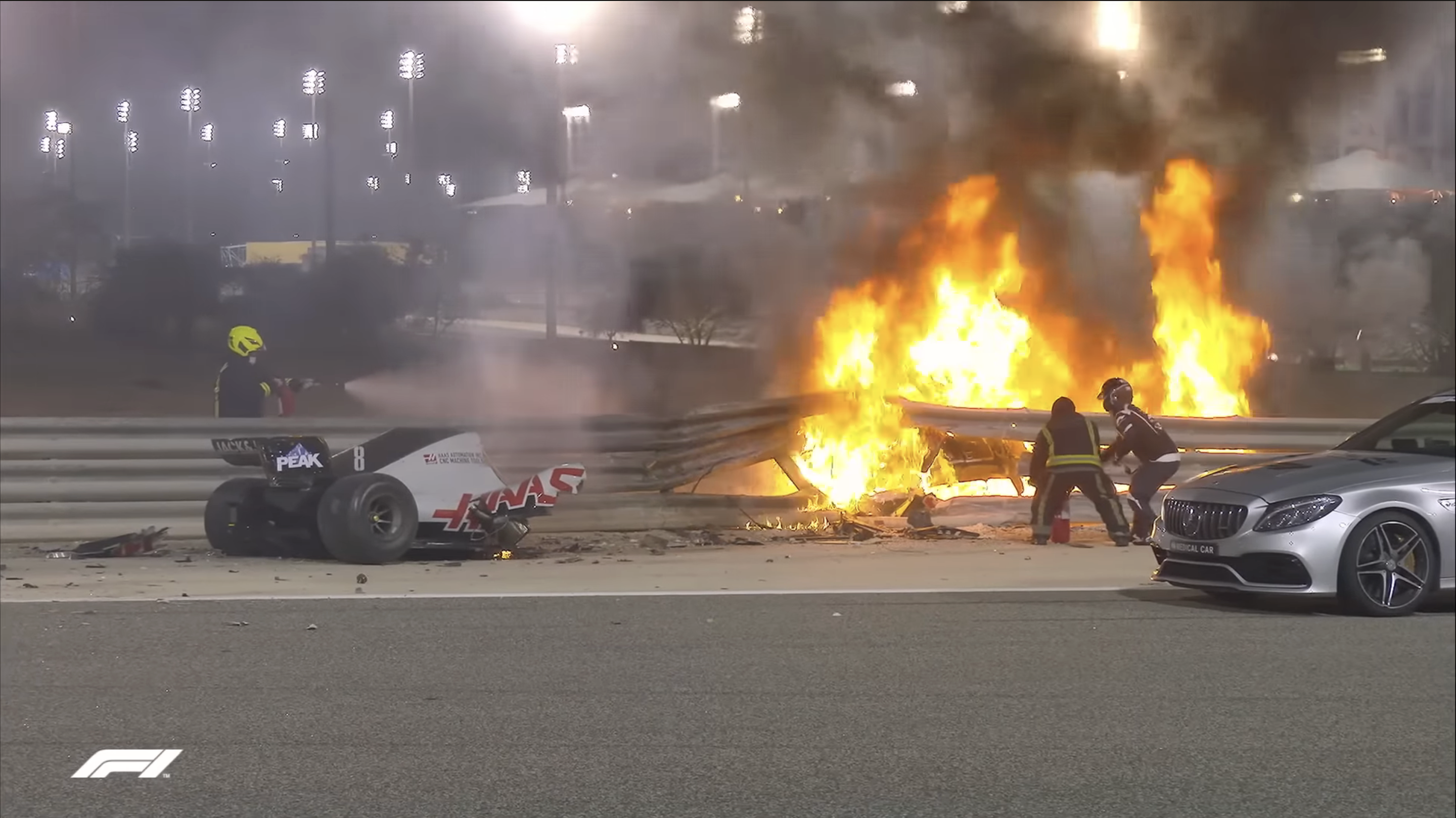
As soon as Grosjean ran through the barriers at 140 mph, his car literally split in two and was immediately engulfed in flames. The race was quickly red-flagged by the stewards. Most drivers had also spotted the fireball and were anxiously reacting to the crash on the radio.
Marshalls quickly responded to the scene and began trying to extinguish the fire while Grosjean remained in the driver’s seat. During those excruciating 28 seconds, engineers, drivers, technicians, and fans alike could do nothing but watch in horror. With the fire burning, it wasn’t safe for anyone to attempt to approach the car and rescue Grosjean.
Suddenly, Grosjean emerged through the flames and was visible on the opposite side of the barrier. As the marshals continued to extinguish the fire, he was quickly escorted into a safety car. In an amazing display of courage and bravery, Grosjean chose to walk himself from the safety car to the ambulance for medical evaluation.
Grosjean’s survival truly felt like a miracle. When asked about the events of that crash, Grosjean noted that it reminded him of Niki Lauda’s crash in 1976.
I stayed 28 seconds in the flames but it seemed much longer, as I tried to get out of the tub three times. After this accident, I’m happy to be alive. To get out of the seat, I was able to remove my seat belt. The steering wheel was no longer there, [it] probably flew off during the impact.
“I was more afraid for my relatives, my children in the first place, but also my father and my mother. I was not really afraid for myself. I saw death coming, I had no other option but to get out of there.
This easily could have been a fatal crash, but somehow Grosjean walked away suffering burns to his hands and a sprained ankle.
Crash aftermath and FIA investigation
Once Grosjean’s safety had been confirmed, attention immediately turned to the circumstances of the crash. How could such a thing happen in the modern, safer era of Formula 1, and how did Grosjean survive?
An investigation into the accident was launched by the FIA, which found that Grosjean’s car struck the guardrail barrier with an impact of 67G. Due to the heavy impact, the car’s survival cell, where the driver sits, dislodged from the power train assembly, splitting the car in two.
While breaching the barrier was concerning, the fire was ultimately what made this crash so dangerous. During the impact, the fuel hatch was also dislodged, causing fuel to spill out of the fuel tank and causing a fire. Once the front half of the car came to rest, Grosjean’s left foot was trapped. To escape, he was forced to remove his foot from his racing boot.
Two main things kept Grosjean safe and alive: His fire-resistant suit and the halo device. Without fireproof gear, Grosjean would have suffered severe burns across his body or would not have been able to self-extricate at all. Thanks to the halo device absorbing impact, Grosjean’s head avoided direct impact with the barrier.
Alongside much of the Formula One community, Grosjean was very against the halo when it was first introduced. Ironically, the safety device that was hated by so many ended up saving his life.
What did we learn from Grosjean’s accident?
Romain Grosjean’s crash is a sobering reminder that nothing can eliminate the danger of Formula 1.
That being said, modern safety advancements absolutely saved his life. Thanks to the halo and fireproof suit, a quick response from race marshals, and Grosjean’s own bravery, this story was spared a tragic ending. No title will ever matter as much as protecting the safety of Formula One drivers.

Leave a Reply